前两讲介绍了 Interceptor 和 Hook。本讲把视线转向 Tool:模型拿到哪些工具描述,调用请求如何执行,结果又怎样回到 Agent 的状态中。
概述
本讲介绍 Spring AI Alibaba Agent Framework 的 Tool(工具)系统,沿着工具定义、注册、调用和状态更新的顺序,阅读 ToolCallback、AgentTool 以及模型节点与工具节点之间的协作。
入口类说明
ToolCallback - 工具回调接口
ToolCallback 是 Spring AI 提供的工具接口。阅读时重点关注工具如何描述自己、接收调用参数并返回结果。
核心职责:
- 定义工具名称和描述
- 定义工具输入输出 Schema
- 执行工具调用
- 返回工具结果
AgentTool - Agent 作为工具
AgentTool 把 ReactAgent 封装为工具,让其他 Agent 可以通过工具接口调用它。
核心职责:
- 将 Agent 转换为 ToolCallback
- 执行 Agent 调用
- 返回 Agent 响应
关键代码:
public class AgentTool implements BiFunction<String, ToolContext, AssistantMessage> {

	private final ReactAgent agent;

	public AgentTool(ReactAgent agent) {
		this.agent = agent;
	}

	@Override
	public AssistantMessage apply(String input, ToolContext toolContext) {
		OverAllState state = (OverAllState) toolContext.getContext().get("state");
		try {
			// Copy state to avoid affecting the original state.
			// The agent that calls this tool should only be aware of the ToolCallChoice and ToolResponse.
			OverAllState newState = agent.getAndCompileGraph().cloneState(state.data());

			// Build the messages list to add
			// Add instruction first if present, then the user input
			// Note: We must add all messages at once because cloneState doesn't copy keyStrategies,
			// so multiple updateState calls would overwrite instead of append
			java.util.List<Message> messagesToAdd = new java.util.ArrayList<>();
			if (StringUtils.hasLength(agent.instruction())) {
				messagesToAdd.add(new AgentInstructionMessage(agent.instruction()));
			}
			messagesToAdd.add(new UserMessage(input));

			Map<String, Object> inputs = newState.updateState(Map.of("messages", messagesToAdd));

			Optional<OverAllState> resultState = agent.getAndCompileGraph().invoke(inputs);

			Optional<List> messages = resultState.flatMap(overAllState -> overAllState.value("messages", List.class));
			if (messages.isPresent()) {
				@SuppressWarnings("unchecked")
				List<Message> messageList = (List<Message>) messages.get();
				// Use messageList
				AssistantMessage assistantMessage = (AssistantMessage)messageList.get(messageList.size() - 1);
				return assistantMessage;
			}
		}
		catch (Exception e) {
			throw new RuntimeException(e);
		}
		throw new RuntimeException("Failed to execute agent tool or failed to get agent tool result");
	}

	public static ToolCallback getFunctionToolCallback(ReactAgent agent) {
		// convert agent inputType to json schema
		String inputSchema = StringUtils.hasLength(agent.getInputSchema())
				? agent.getInputSchema()
				: (agent.getInputType() != null )
					? JsonSchemaGenerator.generateForType(agent.getInputType())
					: null;

		return FunctionToolCallback.builder(agent.name(), AgentTool.create(agent))
			.description(agent.description())
			.inputType(String.class) // the inputType for ToolCallback is always String
			.inputSchema(inputSchema)
			.toolCallResultConverter(CONVERTER)
			.build();
	}

}
关键特性:
- 状态隔离:通过 cloneState() 创建独立状态,避免影响调用 Agent 的状态
- 指令传递:支持传递 Agent 指令
- Schema 生成:自动生成工具输入 Schema
AgentToolNode - 工具执行节点
AgentToolNode 在 Graph 中执行工具调用:解析请求、交给工具处理,再把响应写回状态。
核心职责:
- 解析工具调用请求
- 执行工具调用
- 处理工具响应
- 支持工具拦截器
关键代码:
public class AgentToolNode implements NodeActionWithConfig {

	private List<ToolCallback> toolCallbacks = new ArrayList<>();

	private List<ToolInterceptor> toolInterceptors = new ArrayList<>();

	private ToolCallbackResolver toolCallbackResolver;

	@Override
	public Map<String, Object> apply(OverAllState state, RunnableConfig config) throws Exception {
		List<Message> messages = (List<Message>) state.value("messages").orElseThrow();
		Message lastMessage = messages.get(messages.size() - 1);

		Map<String, Object> updatedState = new HashMap<>();
		Map<String, Object> extraStateFromToolCall = new HashMap<>();
		if (lastMessage instanceof AssistantMessage assistantMessage) {
			// execute the tool function
			List<ToolResponseMessage.ToolResponse> toolResponses = new ArrayList<>();
			for (AssistantMessage.ToolCall toolCall : assistantMessage.getToolCalls()) {
				// Execute tool call with interceptor chain
				ToolCallResponse response = executeToolCallWithInterceptors(toolCall, state, config, extraStateFromToolCall);
				toolResponses.add(response.toToolResponse());
			}

			ToolResponseMessage toolResponseMessage = new ToolResponseMessage(toolResponses, Map.of());
			updatedState.put("messages", toolResponseMessage);
		} else if (lastMessage instanceof ToolResponseMessage toolResponseMessage) {
			// Handle incremental tool execution
			// ...
		} else {
			throw new IllegalStateException("Last message is not an AssistantMessage or ToolResponseMessage");
		}

		// Merge extra state from tool calls
		updatedState.putAll(extraStateFromToolCall);
		return updatedState;
	}
AgentLlmNode - LLM 节点
AgentLlmNode 负责调用 LLM,同时把可用工具的信息传给模型。
关键代码:
public class AgentLlmNode implements NodeActionWithConfig {

	private List<ToolCallback> toolCallbacks = new ArrayList<>();

	private List<ModelInterceptor> modelInterceptors = new ArrayList<>();

	private ChatClient chatClient;

	@Override
	public Map<String, Object> apply(OverAllState state, RunnableConfig config) throws Exception {
		// add streaming support
		boolean stream = config.metadata("_stream_", new TypeRef<Boolean>(){}).orElse(true);
		if (stream) {
			@SuppressWarnings("unchecked")
			List<Message> messages = (List<Message>) state.value("messages").get();
			augmentUserMessage(messages, outputSchema);
			renderTemplatedUserMessage(messages, state.data());

			// Create ModelRequest
			ModelRequest modelRequest = ModelRequest.builder()
					.messages(messages)
					.options(toolCallingChatOptions)
					.context(config.metadata().orElse(new HashMap<>()))
					.build();

			// Create base handler that actually calls the model with streaming
			ModelCallHandler baseHandler = request -> {
				try {
					Flux<ChatResponse> chatResponseFlux = buildChatClientRequestSpec(request).stream().chatResponse();
					return ModelResponse.of(chatResponseFlux);
				} catch (Exception e) {
					return ModelResponse.of(new AssistantMessage("Exception: " + e.getMessage()));
				}
			};

			// Chain interceptors if any
			ModelCallHandler chainedHandler = InterceptorChain.chainModelInterceptors(
					modelInterceptors, baseHandler);

			// Execute the chained handler
			ModelResponse modelResponse = chainedHandler.call(modelRequest);
			return Map.of(StringUtils.hasLength(this.outputKey) ? this.outputKey : "messages", modelResponse.getMessage());
		} else {
			// Non-streaming mode
			// ...
		}
	}
工具注册机制
工具注册流程
工具通过以下方式注册:
- 直接注册:通过
ReactAgent.Builder.tools()方法注册; - Interceptor 工具:通过
ModelInterceptor.getTools()方法提供; - 工具解析器:通过
ToolCallbackResolver动态解析;
关键代码:
// Extract regular tools from user-provided tools
		if (CollectionUtils.isNotEmpty(tools)) {
			regularTools.addAll(tools);
		}

		// Extract interceptor tools
		List<ToolCallback> interceptorTools = new ArrayList<>();
		if (CollectionUtils.isNotEmpty(modelInterceptors)) {
			interceptorTools = modelInterceptors.stream()
				.flatMap(interceptor -> interceptor.getTools().stream())
				.collect(Collectors.toList());
		}

		// Combine all tools: regularTools + regularTools
		List<ToolCallback> allTools = new ArrayList<>();
		allTools.addAll(interceptorTools);
		allTools.addAll(regularTools);

		// Set combined tools to LLM node
		if (CollectionUtils.isNotEmpty(allTools)) {
			llmNodeBuilder.toolCallbacks(allTools);
		}

		AgentLlmNode llmNode = llmNodeBuilder.build();

		// Setup tool node with all available tools
		AgentToolNode toolNode = null;
		if (resolver != null) {
			toolNode = AgentToolNode.builder().toolCallbackResolver(resolver).build();
		}
		else if (CollectionUtils.isNotEmpty(allTools)) {
			toolNode = AgentToolNode.builder().toolCallbacks(allTools).build();
		}
		else {
			toolNode = AgentToolNode.builder().build();
		}

		return new ReactAgent(llmNode, toolNode, buildConfig(), this);
工具调用流程
工具调用步骤
- LLM 生成工具调用:AgentLlmNode 调用 LLM,取得包含工具调用的 AssistantMessage;
- 工具调用解析:AgentToolNode 解析 AssistantMessage中的工具调用;
- 工具执行:通过工具拦截器链执行工具调用;
- 响应生成:将工具执行结果封装为 ToolResponseMessage;
- 状态更新:更新状态中的消息列表;
关键代码:
/**
	 * Execute a tool call with interceptor chain support.
	 */
	private ToolCallResponse executeToolCallWithInterceptors(
			AssistantMessage.ToolCall toolCall,
			OverAllState state,
			RunnableConfig config,
			Map<String, Object> extraStateFromToolCall) {

		// Create ToolCallRequest
		ToolCallRequest request = ToolCallRequest.builder()
				.toolCall(toolCall)
				.context(config.metadata().orElse(new HashMap<>()))
				.build();

		// Create base handler that actually executes the tool
		ToolCallHandler baseHandler = req -> {
			ToolCallback toolCallback = resolve(req.getToolName());
			String result = toolCallback.call(
				req.getArguments(),
				new ToolContext(Map.of("state", state, "config", config, "extraState", extraStateFromToolCall))
			);
			return ToolCallResponse.of(req.getToolCallId(), req.getToolName(), result);
		};

		// Chain interceptors if any
		ToolCallHandler chainedHandler = InterceptorChain.chainToolInterceptors(
			toolInterceptors, baseHandler);

		// Execute the chained handler
		return chainedHandler.call(request);
	}

	private ToolCallback resolve(String toolName) {
		return toolCallbacks.stream()
			.filter(callback -> callback.getToolDefinition().name().equals(toolName))
			.findFirst()
			.orElseGet(() -> toolCallbackResolver.resolve(toolName));
	}
工具扩展机制
自定义工具实现
开发者可以通过以下方式扩展工具:
- 实现 ToolCallback 接口:创建自定义工具;
- 使用 FunctionToolCallback:将函数转换为工具;
- AgentTool:将 Agent 转换为工具;
工具类型
- 函数工具:通过 FunctionToolCallback 将 Java 函数转换为工具
- Agent 工具:通过 AgentTool 将 Agent 转换为工具
- Interceptor 工具:通过 ModelInterceptor.getTools() 提供工具
关键类关系
下面的类图展示了 Tool 系统的类关系:
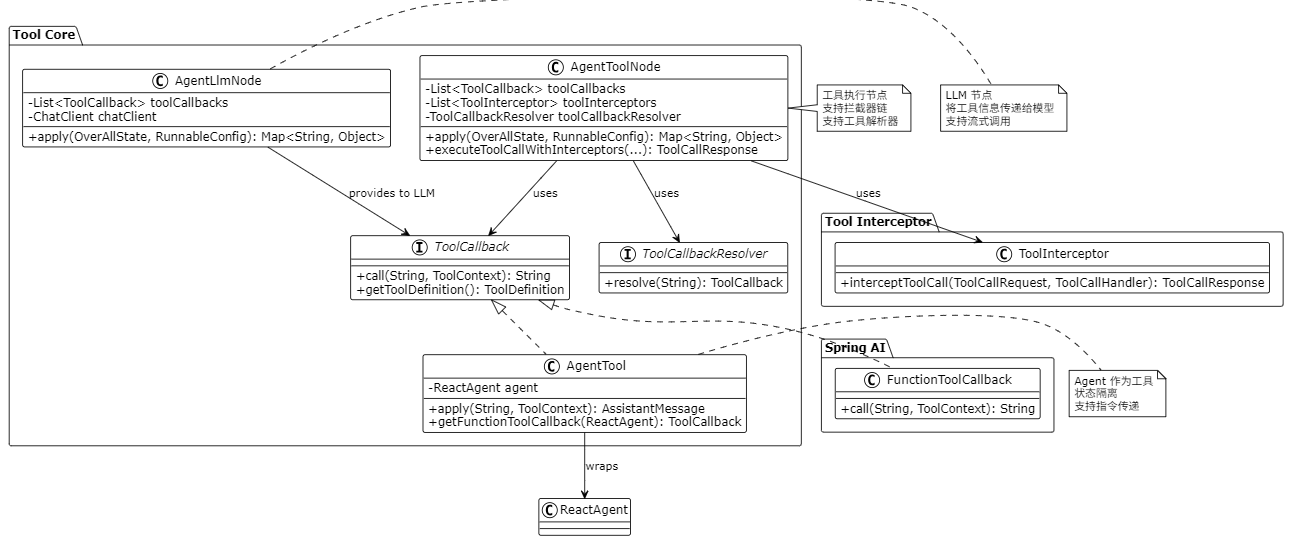
Tool 系统类关系图,沿用原材料配图。
关键流程
下面的时序图展示了工具调用流程: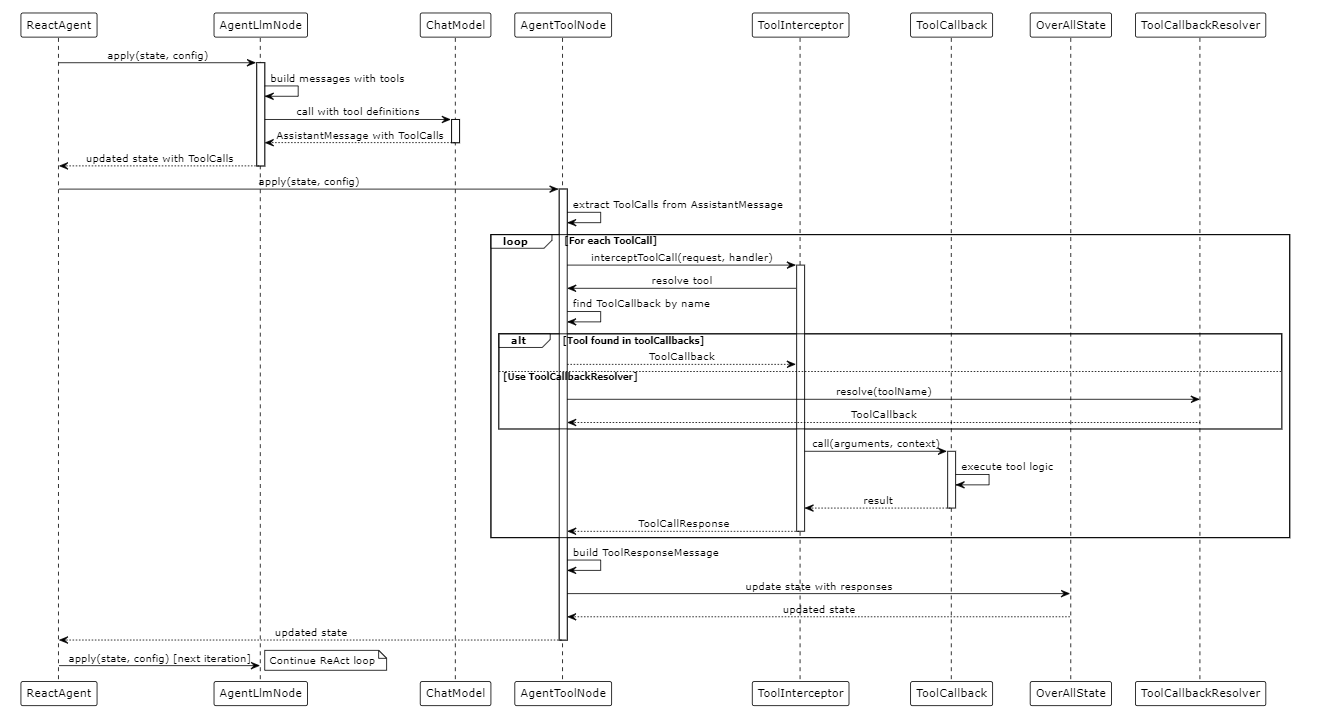
Tool 工具调用流程图,沿用原材料配图。
实现关键点说明
1. 工具注册机制
工具通过多种方式注册:
- 直接注册:通过 Builder 的 tools() 方法
- Interceptor 工具:通过 ModelInterceptor.getTools()
- 动态解析:通过 ToolCallbackResolver
2. 工具调用流程
工具调用经过以下步骤:
- LLM 生成工具调用请求;
- AgentToolNode 解析工具调用;
- 通过拦截器链执行工具;
- 生成工具响应;
- 更新状态;
3. 拦截器支持
工具调用支持拦截器:
- ToolInterceptor 可以拦截工具调用
- 支持请求修改和响应处理
- 支持重试、错误处理等功能
4. Agent 作为工具
Agent 可以作为工具被调用:
- 通过 AgentTool 封装
- 状态隔离,不影响调用 Agent
- 支持指令传递
5. 工具解析器
支持动态工具解析:
- ToolCallbackResolver 接口
- 可以按需加载工具
- 支持工具发现机制
6. 状态管理
工具调用可以更新状态:
- 通过 extraStateFromToolCall 传递额外状态
- 工具响应添加到消息列表
- 支持状态合并
工具扩展示例
创建自定义工具
// 1. 使用 FunctionToolCallback
FunctionToolCallback tool = FunctionToolCallback.builder("myTool", (input, context) -> {
    // 工具逻辑
    return "result";
})
.description("My custom tool")
.build();

// 2. 实现 ToolCallback 接口
public class MyTool implements ToolCallback {
    @Override
    public String call(String arguments, ToolContext context) {
        // 工具逻辑
        return "result";
    }

    @Override
    public ToolDefinition getToolDefinition() {
        return ToolDefinition.builder()
            .name("myTool")
            .description("My custom tool")
            .build();
    }
}

// 3. 将 Agent 转换为工具
ReactAgent subAgent = ReactAgent.builder()
    .name("subAgent")
    .description("Sub agent")
    .model(model)
    .build();

ToolCallback agentTool = AgentTool.getFunctionToolCallback(subAgent);
总结说明
核心设计理念
- 统一接口:所有工具实现
ToolCallback接口; - 灵活注册:支持多种工具注册方式;
- 拦截器支持:工具调用支持拦截器链;
- Agent 工具化:Agent 可以作为工具被调用;
关键优势
- 灵活性:支持多种工具类型和注册方式
- 可扩展性:易于添加新的工具实现
- 可组合性:Agent 可以作为工具,实现 Agent 嵌套
- 拦截器支持:支持工具调用的拦截和修改
解决的问题
- 工具集成:统一工具接口,简化工具集成
- Agent 嵌套:通过 AgentTool 实现 Agent 嵌套调用
- 动态工具:通过 ToolCallbackResolver 支持动态工具加载
- 工具拦截:通过拦截器支持工具调用的增强
使用场景
- 函数工具:将业务函数封装为工具
- Agent 工具:将 Agent 封装为工具,实现多 Agent 协作
- Interceptor 工具:通过拦截器提供内置工具
- 动态工具:通过解析器动态加载工具
系列回顾
这套资料从 Graph 的定义、执行与存储,读到 Agent 的编排和远程协作,再通过 Interceptor、Hook 与 Tool 了解扩展入口。本讲的工具注册、拦截器链和状态更新,可以与前几讲对照阅读。
返回课程目录,或回到第十讲:Hook 生命周期扩展复习生命周期中的扩展位置。